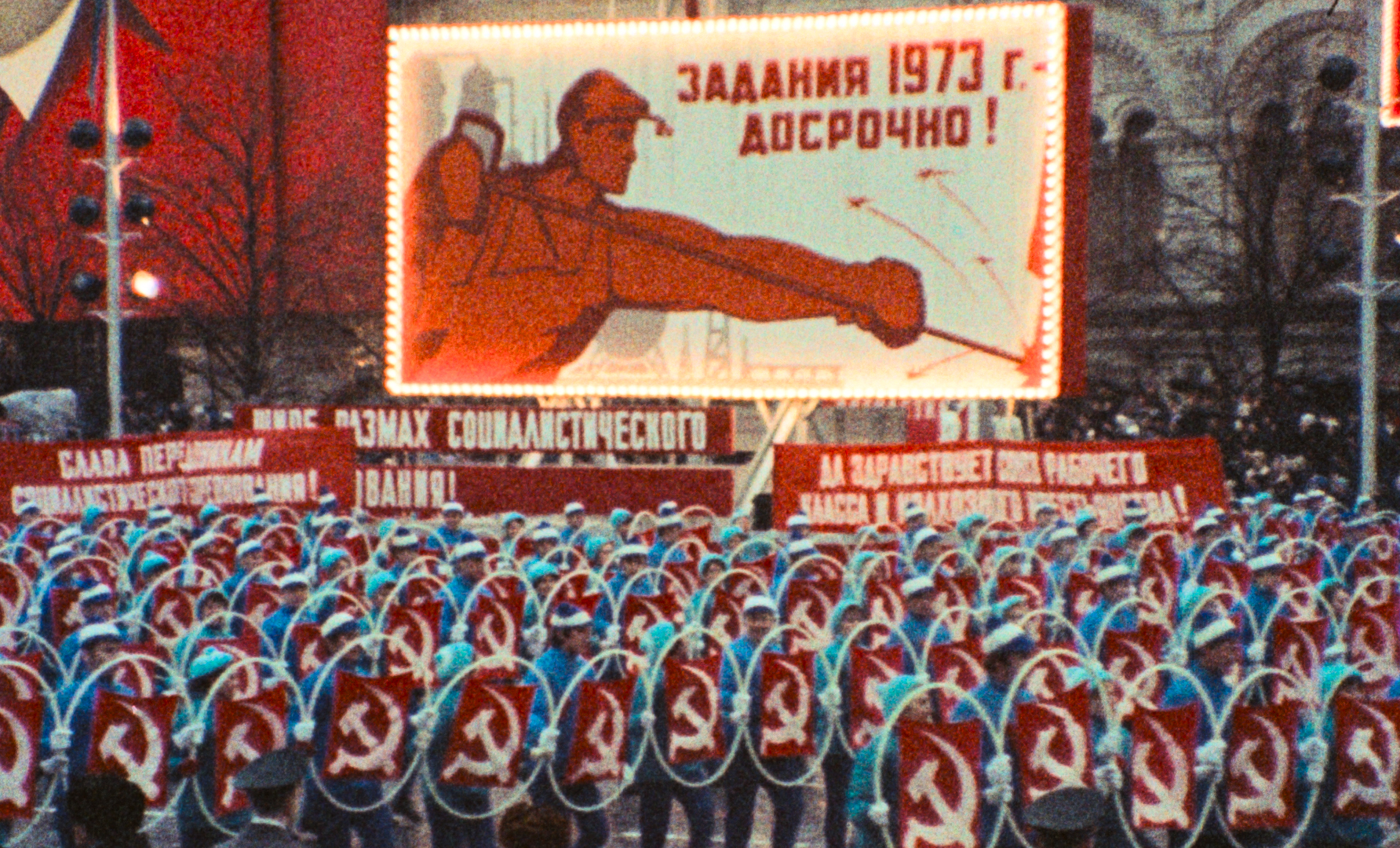
History, I’m pretty sure, can be whatever we want it to be. But history as a procession of empires is a more popular narrative than most; whether you’re a communist (Marx), a fascist (Spengler), or one of those in between. There must be something natural about empires, or at least something natural about thinking about them. But, Sergei Loznitsa shows us they can also be ridiculous.
As a Ukrainian-raised filmmaker, Loznitsa knows better than I or most my few readers the painful reality of ridiculous empires. But his latest documentary doesn’t focus on the oppressive, or, I suppose, ‘consciously’* oppressive, instruments of power. Instead, ambitiously, he stitches together archival material that makes the incompatibility of its component parts self-evident.
The footage, shot by Italian filmmakers in the early-70s, branches away from Moscow into the wider Soviet landscape. Loznitsa lingers on dissimilarities, a parade in Red Square gives way to an old woman washing her clothes in ice water in… was it Suzdal? All this everyday life interspersed with red iconography makes the absurdity of the whole construction unavoidable. But, while I watched I wondered if these absurd elements of the USSR were not the same qualities that ‘liberal westerners’ (a declining species) have been trying to overcome – differences of race, language, and culture?
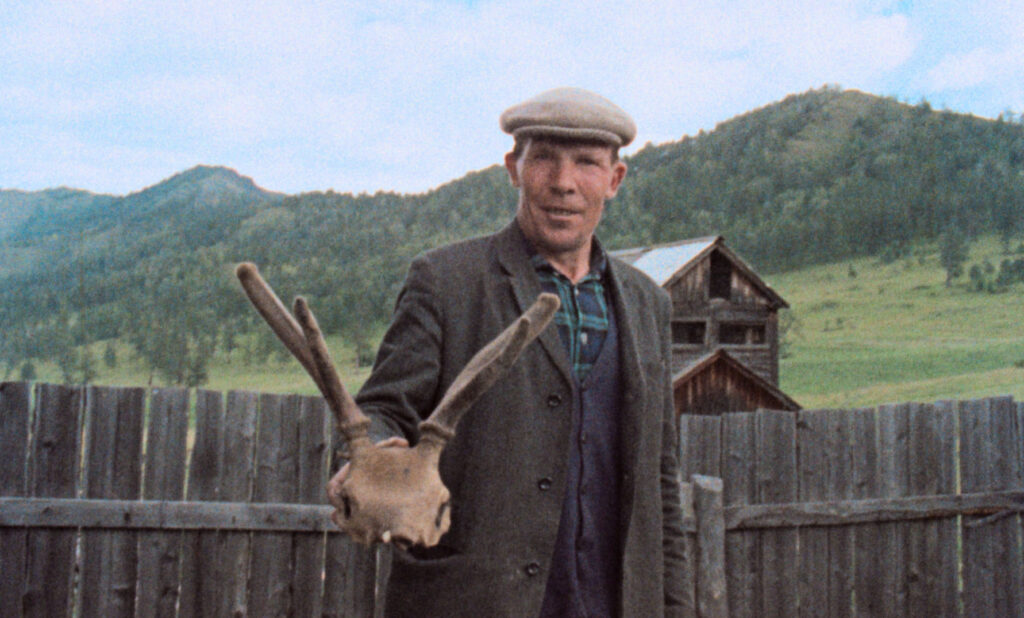
Loznitsa appeals to our sense of the bizarre. The footage from the Yakut Autonomous Soviet Socialist Republic is a highlight – did anyone know they raced reindeer? The Politburo did. Leninist imagery follows the viewer across the empire, and Soviet ideals of hard work and collective effort are especially evident in factories and schools. Ballet in Tallinn is set against mosques in Bukhara, Russian hippies attract (justifiably) disgruntled stares in Yakutia. Aside from a lone KGB officer, disturbed by a camera when he just wants his lunch, the sinister machinery underpinning the empire remains off screen.
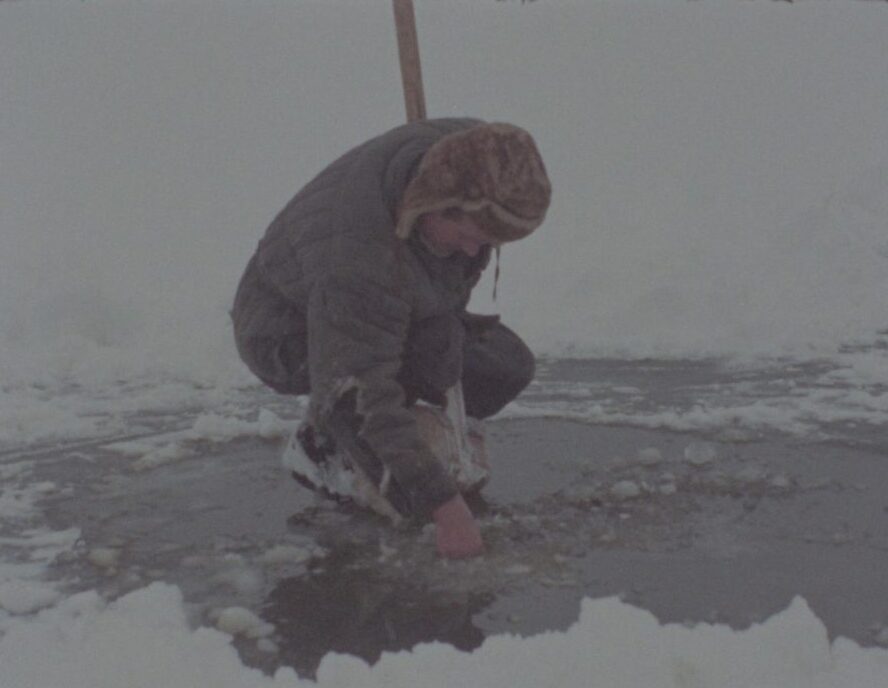
It’s an effective approach, but I found myself wondering about the footage. Who were the filmmakers? Information online and in subsequent (English language) reviews is scarce. The title of the archive that holds the footage – the ‘Audiovisual Archive of the Democratic and Labour Movement’ – gives some socialist clues. Archival listings reveal that this footage was collected by a group of established ethnographic documentary filmmakers, with the cooperation of the Soviet authorities. If you think the footage is impressive, one of the filmmakers, Folco Quilici, had already won a Silver Bear in Berlin and a Special Prize at Venice decades before.
Well that changes the impression. Loznitsa’s footage was, to an extent, already compiled to showcase the heterogeneity of the empire. At the time, Sergio Giordani, who salvaged some of the footage for television in 1975, assured a critic that the question of nationality was central to the show. Did Loznitsa leave this out to disguise some sort of criminal unoriginality? I don’t think he will be too distracted by that weak accusation. Of course, unless he was watching Unitelefilm in 1975, he could not have seen the lost TV episodes. But I’m still wondering about those Soviet officials who cooperated with the project. Is Loznitsa portraying the empire in the way they wanted it, at least for a brief time, to be seen?
Rather than provide clumsy contextual placards, Loznitsa resorts to a few cinematic flourishes. A bright red screen and bell chime announces movement from one region to another. Engaging in some shameless plagiarism, one Letterboxd review – which will undoubtedly get and deserve more traction than this review – illustrated this effect:
🟥 🟥 🟥
🟥 🔔 🟥
🟥 🟥 🟥
I think the Venice audience also wanted to know more. Or, at least one Italian member of the audience did. When the projector froze in the midst of a Yakut procession – the only technical fault I saw this year, if you ignore a leaky roof – he took ten minutes to voice his thoughts to the auditorium. Translated with the use of some untrustworthy AI tools, and the validation of the untrustworthy Italian author of the above successful Letterboxd review, he seems to have suggested captions could have been implemented during these red screens. I don’t agree with the Italian man, but I admire his confidence. I also admire his imagination: his take on a scene where a reindeer’s horns are sawn off, presumably as standard cattle management, led him to consider Rudolf Steiner, horns as extensions of an animal’s ‘energy,’ and, in connection, his grandfather: ‘who would look at the moon before sowing [crops] because he believed it influenced the cycle of sowing and harvesting.’
I’m a bit more boring than that. I wish my mind could wander like his, but I like the safety of looking for the answers after the film; it means I don’t need to commit myself to an embarrassing opinion before considering all the embarrassing opinions available. More to my taste is a subtle and seemingly undiscussed contextual tool Loznitsa uses – the repetition of a republics full title: the Russian Soviet Federative Socialist Republic. He didn’t need to do this, it was the largest division of the USSR and much of the film takes place there. It might have been repeated to emphasise absurd scale of this particular republic, but combined with the titles of other regions it provides a consistent Soviet stamp on the individual nations. I’ve always stalled on the word ‘federal’ in connection with the Soviet Union. It’s never been clear to me why this political system, one that we imagine – wrongly – as the USA’s novel contribution to constitutional history, was adopted by America’s bête noire.
That, finally, returns me to that question of union. A declining, but once popular reason for federalism was to unite different groups in a stronger state. Why is this seen as more natural in the USA than the USSR? Are we too reliant on race when we imagine what communities can live alongside one another?* Returning to my earlier point, I don’t think the USSR was necessarily an unnatural construction, it just relied on darker, political, but no less natural impulses. If we think for a moment about Yakut, which presents the starkest contrast with Moscow (excepting, perhaps, Azerbaijan – but that would be relying on racial thinking again), we will remember that it never achieved independence from the Soviet Union and is still part of Russia today.
Russia renewed its territorial aggrandisement over the last decade or so, if it ever really abandoned it. Loznitsa was outspoken on Russia’s relationship with Europe in the lead-up to Venice. He said the European Commission’s decision to remove a £1.7 million grant to the Art Biennale, a punishment for reopening the Russian Pavilion, was akin to ‘a punishment in kindergarten.’ He’s right. It’s hypocritical. Europe is in the midst of a gas-induced rehabilitation of their neighbour, and I get the sense that hostile attitudes are fading.
Loznitsa said he would never go to the Russian Pavilion, but for shame I did; or tried, my morality rescued by the European Commission that forced it closed again. Meanwhile, at the Film Festival I sat, enjoyed, and agreed with the jury that gave Ilya Khrzhanovsky the Silver Lion for Dau, a film that attracted misguided Ukrainian opposition for its Russian associations.
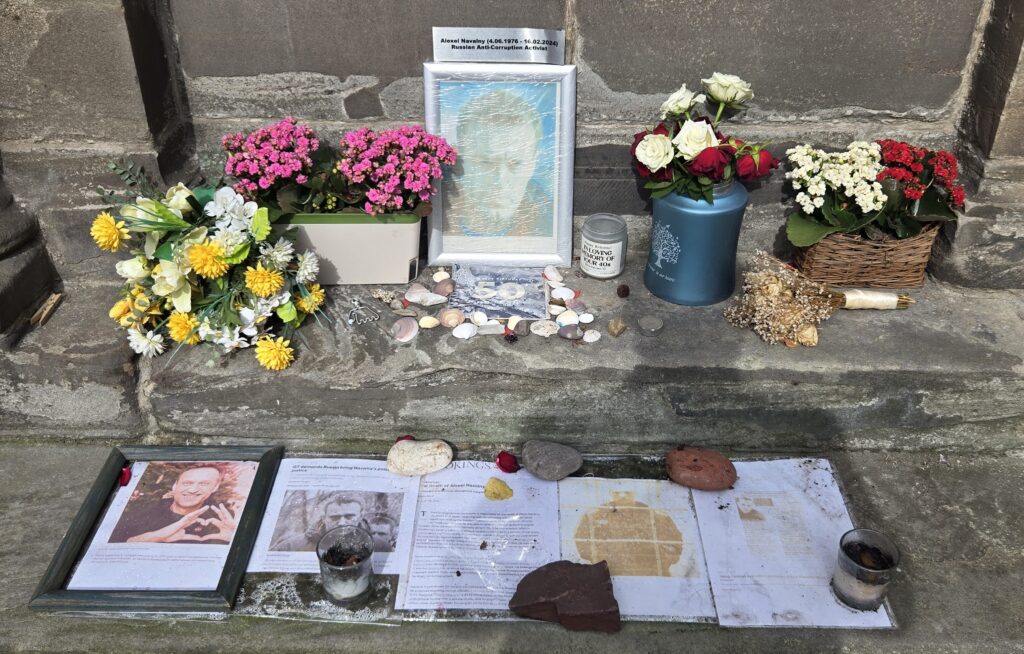
I don’t think Loznitsa would advocate a cultural boycott. But, maybe I’m too light on Russia. I wrote this a week after the Venice Film Festival ended, in the National Library of Scotland. In a short coffee break I walked passed a medieval (albeit, rebuilt) site for ceremonies, hangings, and burnings called the Mercat Cross. At the foot of this monument is a vigil for Alexei Navalny. Loznitsa’s film ended with a title card stating the date the USSR died, but Navalny is a reminder that not everything passed away with it. Although ‘Imperium’ was not directly concerned with assassinations or gulags, I wonder which approach – highlighting the oppression or the absurdity – is more effective? Loznitsa’s is certainly more unusual.
